
The short answer
If your furnace blows cool air, cycles on and off, makes new noises, or shows an error code, it likely needs a repair visit. Most problems come down to replaceable parts such as igniters, sensors, switches, or motors. Bay Area Air District rules don't require you to replace a working furnace, so repairing it remains a sound option.
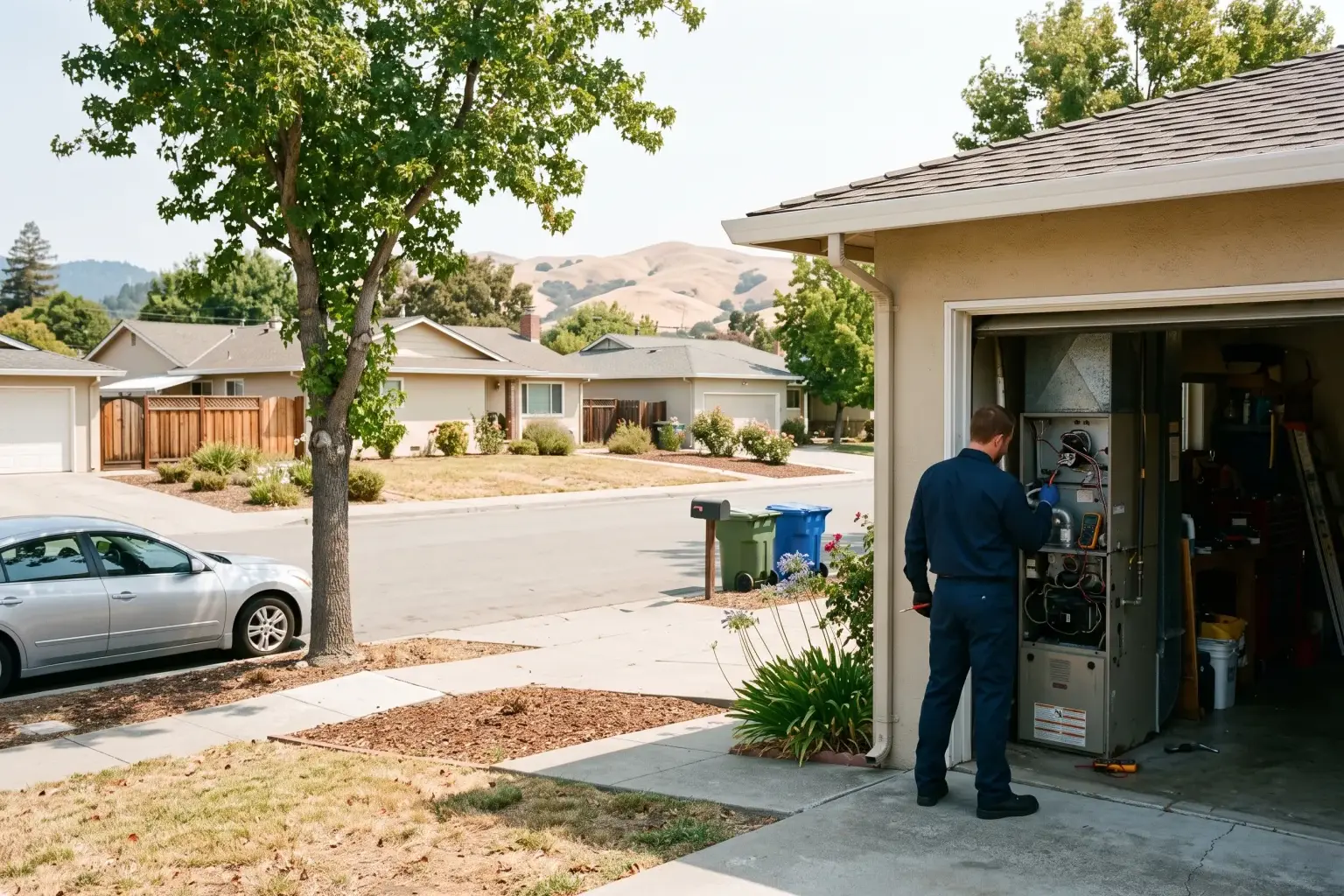
When your furnace stops heating, short-cycles, or starts making noises it didn't make last winter, you want a clear answer about what's wrong and what it will take to fix it. ClimateEdge HVAC Service repairs gas furnaces for homeowners in Fremont and nearby cities, including Newark, Union City, and Milpitas. This page covers the warning signs worth acting on, what our technicians check during a repair visit, how to weigh repair against replacement under current Bay Area rules, and what shapes the cost of the work.
Signs Your Furnace Needs Repair
Many furnace problems give some warning before the heat quits completely. Catching them early usually means a simpler repair and less time in a cold house. Schedule service if you notice any of the following:
If you smell gas, leave the house right away and call your gas utility or 911 from outside. If a carbon monoxide alarm goes off, get everyone outdoors and ventilate the home. In either case, don't restart the furnace. A technician should inspect it before it runs again.
- The blower runs but the air from the vents is cool or lukewarm.
- The furnace turns on and off every few minutes without warming the house. This is called short-cycling.
- Some rooms stay noticeably colder than others, even with the vents open.
- New noises, such as banging at startup, squealing, scraping, or repeated clicking without ignition.
- The burner flame looks yellow or flickers instead of burning steady and mostly blue.
- Heating bills rise even though you haven't changed how you use the thermostat.
- More dust in the house, a musty odor from the vents, or a burning smell that lasts past the first few runs of the season.
- The furnace's indicator light is flashing an error code.
What We Check During a Repair Visit
A furnace repair visit starts with diagnosis, not parts. Our technicians work through the system in order so the repair fixes the cause and not just the symptom.
Once we find the problem, we explain what failed, why it failed, and what the repair involves. We do this before any work begins.
- Thermostat settings, wiring, and batteries, to rule out a control problem before opening the furnace.
- Air filter condition and return airflow. A clogged filter is one of the most common causes of overheating and short-cycling.
- The ignition system, including the hot surface igniter or pilot assembly and the flame sensor.
- Gas valve operation and burner condition.
- Safety controls, such as the high-limit switch, rollout switches, and pressure switch.
- The draft inducer motor and venting, to confirm combustion gases are leaving the home properly.
- The blower motor, capacitor, and belt or blower wheel, plus the control board and any stored error codes.
- The heat exchanger, inspected visually for cracks, corrosion, or signs of overheating.
- Carbon monoxide levels near the furnace and at the supply registers.
Repair or Replace?
Most furnace problems are worth repairing. Igniters, flame sensors, pressure switches, capacitors, and blower motors are all replaceable parts, and fixing them can keep a sound furnace running for years. Replacement starts to make sense in a few situations: the heat exchanger is cracked, repairs are becoming frequent, replacement parts are hard to get, or the system can no longer keep the home comfortable.
Bay Area rules are also part of the decision. Under the Bay Area Air District's Rule 9-4, natural gas furnaces manufactured from 2029 on must meet a zero-NOx emission standard. In practice, this points homeowners toward heat pumps when a furnace is replaced after that date. The rule does not require you to replace a furnace that's working. It applies only when an existing furnace fails or is replaced, so repairing your current furnace is still a reasonable choice.
If replacement is on the table, we'll go over both options, a new furnace and a heat pump. That way you can compare comfort, operating costs, and how each one fits your home's ductwork and electrical service. The federal Energy Efficient Home Improvement Credit (25C) covered only qualifying heat pumps placed in service before December 31, 2025, so it isn't available for new installations. Bay Area homeowners can check BayREN and their local clean energy provider for current heat pump and electrification incentives. Amounts and availability change with each funding cycle, so we confirm the current offer before we include it in a quote.
What Affects the Cost of Furnace Repair
We can't give a reliable cost for a furnace repair until we've diagnosed the problem, because two furnaces with the same symptom can need very different fixes. These are the main factors:
After the diagnosis, you'll get a clear written estimate, and you decide whether to go ahead.
- The part that failed. Cleaning a flame sensor and replacing a blower motor are very different jobs.
- Parts availability. Common universal parts are easier to get than model-specific control boards or parts for older units.
- Furnace location. A unit in a tight attic or crawlspace takes longer to work on than one in a garage or closet.
- Age and condition. Older systems may have related wear that's worth fixing at the same time.
- Timing. Visits outside regular hours may be priced differently than scheduled appointments.
- Additional findings. Problems such as a blocked vent or damaged ductwork can add to the job.
How a Furnace Repair Visit Works
When you contact us, we'll ask what the furnace is doing, about how old it is if you know, and where it's installed. This helps the technician arrive with the parts you're most likely to need.
At your home, the technician confirms the symptoms with you, runs the diagnostic checks described above, and explains the findings in plain terms. You'll see the recommended repair and any other options before work starts. Many common repairs can be finished during the same visit. If a part has to be ordered, we'll tell you when to expect it and help you stay as comfortable as possible until then.
After the repair, we run the furnace through a full heating cycle, confirm that it operates safely with steady airflow, and check that the thermostat responds correctly. We'll also point out anything worth watching, such as filter changes or wear that may need attention later.
Furnace Repair by city
- Furnace Repair in NewarkLocal service & repairs
- Furnace Repair in Union CityLocal service & repairs
- Furnace Repair in HaywardLocal service & repairs
- Furnace Repair in East Palo AltoLocal service & repairs
- Furnace Repair in Menlo ParkLocal service & repairs
- Furnace Repair in MilpitasLocal service & repairs
- Furnace Repair in Mountain ViewLocal service & repairs
- Furnace Repair in PleasantonLocal service & repairs
- Furnace Repair in Redwood CityLocal service & repairs
- Furnace Repair in SunnyvaleLocal service & repairs
- Furnace Repair in AthertonLocal service & repairs
- Furnace Repair in Palo AltoLocal service & repairs